
Wednesday One Thing - Sins of the Fathers?
Wednesday One Thing - Sins of the Fathers?

This one is ugly, and this week I'm not going to soften it. No euphemisms, no "a certain European leader," no blanks left for you to fill in. If a name belongs on the page, it's on the page.
But...
Stay with me to the end — because the end is a question, not a verdict.
Sins of the Fathers?
Henry Ford put America on wheels, paid an unheard-of five dollars a day, and built a company whose blue oval is still bolted to millions of vehicles. He's carved into the national memory as a folksy mechanical genius.
He was also one of the most influential bigots this country ever produced. Not a man "of his time" — a man who was ahead of his time, in the worst way imaginable, because one of his most devoted fans was taking notes in Munich.
Here's the part of the biography that stays out of the car commercials. Twelve of them. Check every single one yourself; the links are at the bottom.
- He ran years of antisemitic propaganda. Starting in 1920, Ford's own newspaper, The Dearborn Independent, published a series titled "The International Jew," blaming Jewish people for war, communism, Wall Street, Hollywood — and, I promise I'm not inventing this, jazz.
- He weaponized his dealerships to spread it. Ford dealers were required to stock the paper, and copies were handed out with new cars. The articles were bundled into a book that sold in the hundreds of thousands and was translated into more than a dozen languages.
- He pushed a known hoax as fact. Much of it rested on The Protocols of the Elders of Zion, a forged document, and Ford kept promoting it even after it was publicly exposed as a fake.
- Hitler idolized him. Adolf Hitler kept a portrait of Henry Ford in his office, praised him by name as the one American worth admiring, and singled him out in Mein Kampf — the only American Hitler names in the entire book.
- A Nazi leader credited him under oath. At the Nuremberg trials, Hitler Youth leader Baldur von Schirach testified that reading Ford's "The International Jew" as a young man helped make him an antisemite. Ford's propaganda didn't just echo the Nazis — it fed them.
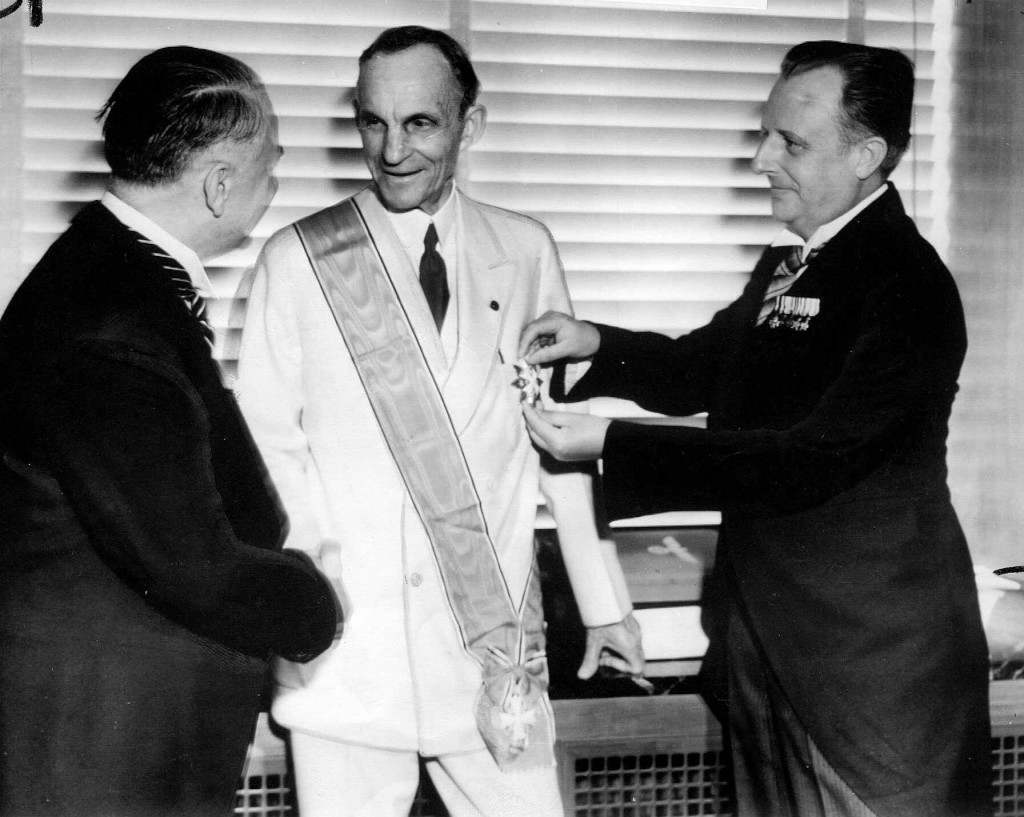
- He accepted the Nazis' highest foreign honor. In July 1938 — months before Kristallnacht — Ford accepted the Grand Cross of the German Eagle, the top decoration the Third Reich awarded a foreigner, pinned on him right there in Detroit. That is the REAL photograph above. He's smiling.
- His German company ran on slave labor. Ford's subsidiary, Ford-Werke in Cologne, used forced and slave laborers and built trucks for the Wehrmacht throughout the war.
- He later got paid for the damage. In 1967 the U.S. government awarded Ford roughly $1.1 million in compensation for wartime bomb damage — to those same Nazi-era German plants.
- His one "apology" was likely a fraud. Facing a lawsuit in 1927, Ford issued a public retraction of his antisemitism. The evidence suggests it was ghostwritten and that he never read it, let alone meant it.
- He kept a private goon squad. Ford's enforcer, Harry Bennett, ran a "Service Department" of in-house muscle. In the 1937 "Battle of the Overpass," Ford men beat union organizers — including future UAW president Walter Reuther — bloody, in front of the press.
- He policed his workers' private lives. To qualify for that famous five-dollar day, employees had to submit to home inspections by Ford's "Sociological Department," which graded their drinking, their housekeeping, and their marriages.
- He built a jungle company town and ran it like a dictator. In the Amazon, Ford built "Fordlandia," imposing Prohibition, American food, and square dancing on Brazilian rubber workers — until the place erupted in riots and collapsed entirely.
That's not a man who made a few bad calls. That's a worldview, in print, with a fan club in Berlin.
Here's the one thing.
Henry Ford died in 1947 — seventy-nine years ago. He's been dead longer than most of us have been alive.
And the name is still on the building. His great-grandson is the executive chairman of Ford Motor Company right now. The charitable foundation his family created — partly, let's be honest, to dodge a brand-new inheritance tax — became one of the largest funders of civil rights and social justice on the planet, and for more than forty years didn't seat a single Ford on its board. His own grandson spent much of his life rebuilding the very bridges the old man burned to the ground.
So — should you drive a Ford?
Here's what I notice: I genuinely don't know. And almost everyone else answers in about half a second, in whichever direction they were already pointed.
How long is the sentence, exactly? One generation? Three? Does the great-grandkid inherit the debt along with the stock? Does a name on a building owe what the man behind it did? If a fortune built on the sin ends up bankrolling the oppositeof the sin, does the ledger ever clear — and who's keeping that ledger? You?
And notice: none of this was ever really about one dead man from Dearborn. It's the family with the bad last name in your own town. The company whose founder turned out to be a monster. The brand, the statue, the scholarship, the street sign. We condemn some of them forever and wave the rest through by Tuesday — and if you're honest about which gets which, the deciding factor usually isn't the size of the sin. It's whether we liked them going in.
I'm not going to settle it for you. I don't think there's a clean answer, and I've grown suspicious of anyone who hands me one too quickly — myself very much included.
But the next time you're asked to forgive one name and bury another, maybe sit in the discomfort for a second — before you decide you knew the rule all along.
That's the one thing.
Check it yourself:
- The newspaper, the book, the forgery, and von Schirach's Nuremberg testimony — U.S. Holocaust Memorial Museum · "The International Jew," Wikipedia
- Hitler's portrait of Ford — "Berlin Hears Ford Is Backing Hitler," New York Times, Dec. 20, 1922 (reprinted)
- The 1938 Grand Cross of the German Eagle, with the photograph — Rare Historical Photos (AP) · Order of the German Eagle, Wikipedia
- Forced labor at Ford-Werke, and the 1967 compensation — Anti-Defamation League
- The Nuremberg proceedings (primary source) — The Avalon Project, Yale Law School
- The 1927 retraction, the overpass beating, and worker treatment — HISTORY · Battle of the Overpass, Wikipedia
- The home inspections — The Henry Ford, Sociological Department
- Fordlandia — The Henry Ford, Ford Rubber Plantations in Brazil
- The foundation, the tax, and the family's long absence from its board — Ford Foundation, Wikipedia · first family member since 1976, Detroit News
- The great-grandson running it now — William Clay Ford Jr., Wikipedia

I didn't find this ugly at all. Knowing our history is imperative - every German school kid visits a Concentration Camp site. There is a move right now to sterilize history - the idea that we shouldn't make slavery seem "worse than it was" because teaching about it makes little white kids feel bad.
Also, I think we know that terrible people can do great things. You can look at both things without justifying the terrible part. I also think punishing a current generation for the sins of the fathers is carrying on an idea of bloodline that I don't agree with. We share genetics with our forbearers, but not necessarily morality
The last thing is this, and I might be a bad person: I drive a Honda because it works. I don't know if there was a Mr Honda, and whether he was a good person. I bank at Wells Fargo, and I know they are assholes, but they are competent. My good-guy credit union feels good to do biz with, but they aren't as competent. I couldn't trade morally superior incompetence for getting the job done.
