Wednesday One Thing - Nine million followers. Zero new viewers. The social media lie finally has a receipt.
Wednesday One Thing - Nine million followers. Zero new viewers. The social media lie finally has a receipt.


Nine million followers. Zero new viewers. The social media lie finally has a receipt.
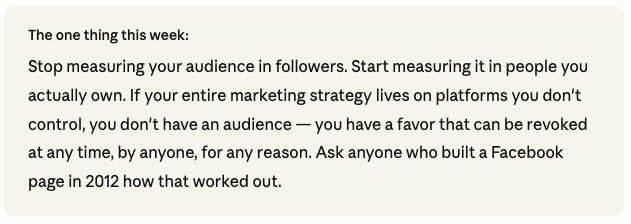
I've been saying this for years. Fifteen years, actually, while managing digital media for a national racing series. I watched driver after driver beg to pour their audience into social media. I watched sponsors get sold on follower counts. I watched grown adults in marketing meetings treat likes as currency.
I kept saying: don't do this. Don't hand your audience to a platform you don't own. And don't you dare confuse a follower with a fan.
Nobody listened. So this week, the racing world handed me the perfect case study. And I'm going to use it.
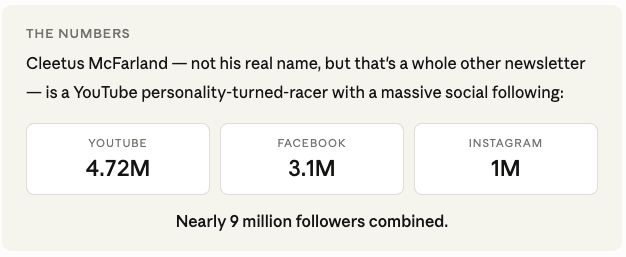
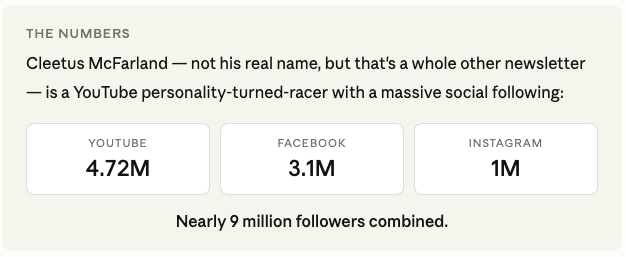
He raced in the ARCA Menards Series at Talladega this spring. ARCA is a junior developmental series — essentially the minor leagues of NASCAR. The media made a big deal of his appearance. His fans were fired up. The crossover potential was off the charts, they said.
The race drew 446,000 viewers on FS1.
Headlines celebrated this as a 41% ratings surge. And technically, yes — it was up from 317,000 the prior year. But here's what they didn't tell you: a few years earlier, before Cleetus was anywhere near this race, ARCA at Talladega drew over 530,000 viewers. So with 9 million followers, the series still hasn't returned to where it was without him.
Let that sink in. Nine million followers produced 129,000 additional viewers. That's a conversion rate of 1.4%.
And here's the question nobody in the trade press is asking: if those 9 million followers were real, engaged, active fans — the way social media platforms and their marketing believers claim — then more people would have tuned in to watch a junior racing series on a cable channel than watch the Daytona 500. The Daytona 500. Let that sit for a second.

Here's what nobody talks about. Social media follower counts are the only metric in the history of media that are cumulative and permanent. When a TV show gets a rating, that's how many people actually watched — that night, in real time. When a newspaper reports its circulation, those are actual subscribers paying actual money. When a radio station reports its reach, that's measured listenership.
But social media? If someone clicked "like" on a Coca-Cola post in 2006 and has been dead since 2014, that person is still a follower. That like never goes away. There is no other form of media on earth — not one — that counts its audience this way. It is the only metric that never resets, never expires, and never reflects whether a single actual human being is paying attention today.
The platforms know this. The agencies that sell against it know this. And they keep selling it anyway, because the numbers look spectacular on a slide deck and nobody in the room wants to be the one to say the emperor has no clothes.
Here's who actually made money off Cleetus at Talladega.
Not ARCA. Not FS1. Not the sponsors on the car.
The only entities that can actually monetize Cleetus McFarland's 9 million followers are Facebook, YouTube, and Instagram — because they're the only ones holding the keys to that audience. They own the relationship. They sell the ad against it. They decide who gets reach and who gets throttled. ARCA can't reach his followers directly. FS1 can't either. They had to hope — genuinely hope — that his fans would voluntarily find their way to a cable channel on a Saturday afternoon.
129,000 of them did. The platforms kept the other 8.87 million.
That is not a partnership. That is a landlord-tenant relationship — and Cleetus is the tenant, paying rent in content every single day, with no deed to show for it.
The real lesson here isn't about ratings. It's about ownership.
Cleetus McFarland needs to stop sharing his audience and start owning it. Every creator does. Every athlete, every brand, every business does.
Here's a simple math problem. If Cleetus had one twentieth — just 5% — of his social following in an owned list. A real email list. A CSV file with names, addresses, and permission to contact. That's 450,000 people he could reach directly, any time, for free, without asking Zuckerberg's permission. That list would be worth more to a sponsor, a merchandise partner, or a ticket seller than all 9 million social followers combined. Because those 450,000 people said yes. They opted in. They raised their hand. And nobody can take them away.
A follower is borrowed. A subscriber is owned. The difference between those two words is the difference between building a business and building someone else's.